


Knowing how to harvest pistachios is an important step that affects their quality, taste, and value. If pistachios are picked at the right time and handled carefully, they stay fresh, clean, and flavorful. Proper harvesting also helps prevent damage and reduces waste. By following the correct steps for picking and processing, farmers can protect their crop and make sure the pistachios are ready for the market in the best condition. Continue reading to understand how are pistachio nuts harvested. Understanding these steps is especially important for producers of persian pistachio, where quality and export standards are highly valued in global markets.
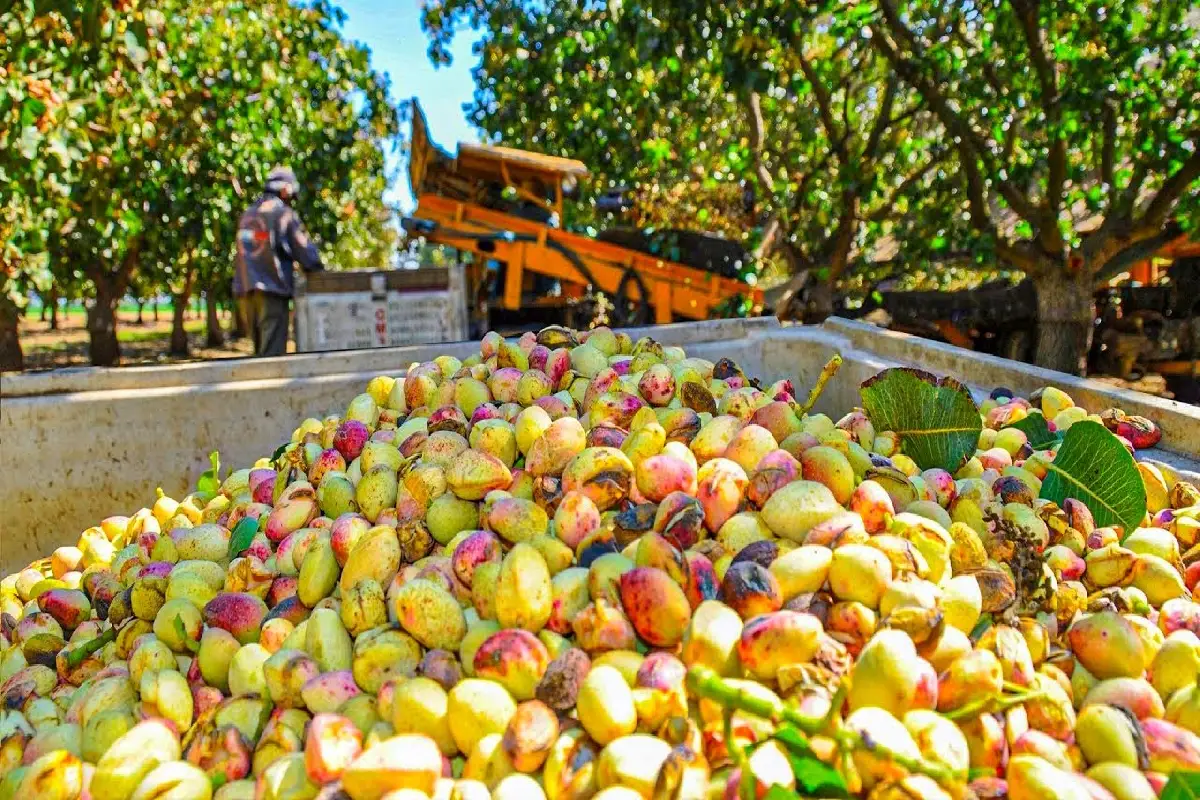
Step-by-step guide: How to harvest pistachios
How to harvest pistachios? Here are the steps:
1. Knowing when pistachios can be picked
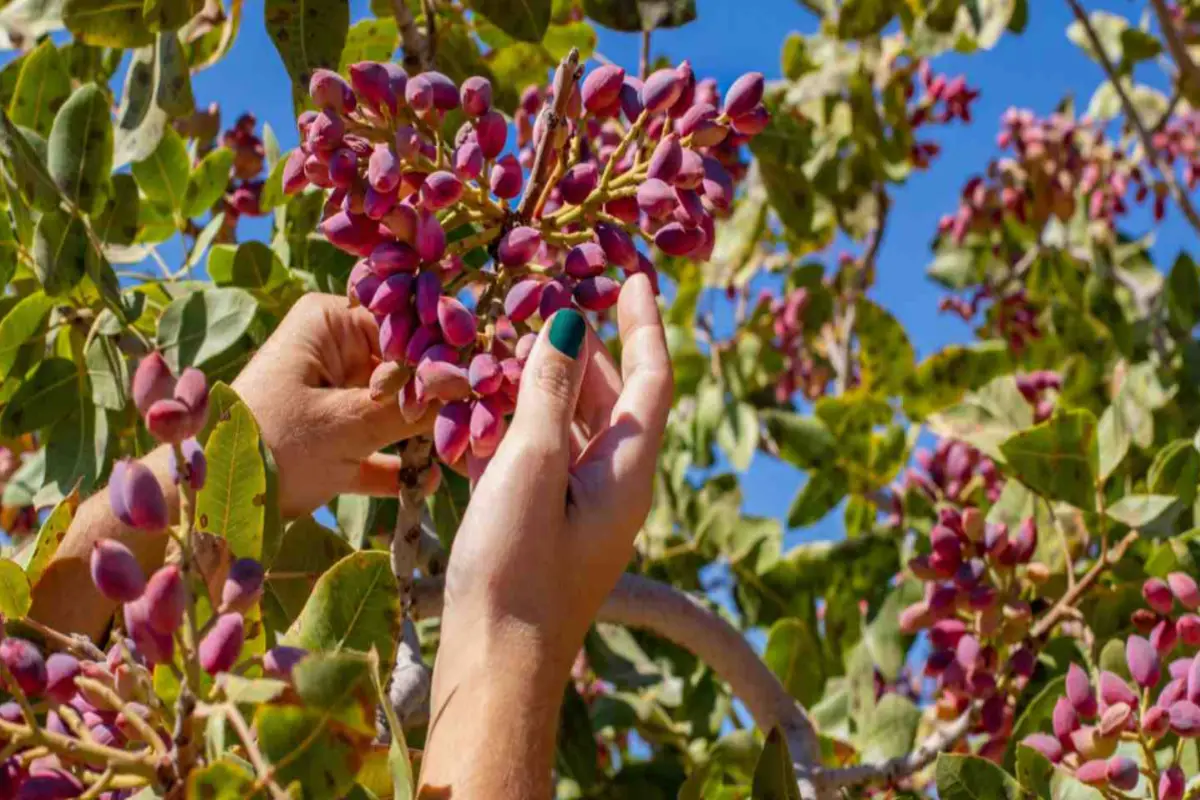
- The hull (soft outer skin) would become colored, and it would start splitting apart, showing a separation between the hull and the hard shell.
- The majority of the nuts in the cluster are in season; if too many of them are still hard and closed, it is advisable to wait a little.
The commercial orchards typically harvest around the end of the summer into the fall, when most nuts have shells that have split and loose hulls. This timing is particularly crucial for premium varieties such as Kalleh Ghouchi Pistachios, which require precise harvesting to maintain their large size and high quality.
2. Prepare
- Lay clean sheets, nets, or tarp under the pistachio tree so that the nuts do not fall on bare soil.
- In this way, the collection becomes quicker and allows keeping the nuts clean and without stones or plant debris, improving the food safety and further processing. Proper preparation is also essential for varieties like Fandoghi Pistachios, which are widely used in processing industries and require clean harvesting conditions.
3. Shake the tree to shake off the ripe nuts
How do you harvest pistachios? There are two predominant methods based on shaking:
- Manual pick: Workers pick by hand by shaking or tapping the branches with a stick or rubber mallet until the ripe pistachios fall on the tarp.
- Mechanical harvesting: In orchards, a kind of machine named a shaker takes hold of the trunk or main branches and vibrates the tree bearing the nuts. So the nuts fall off into the hands of a receiver.
Dry weather is the best time to harvest due to the chances of staining and fungal development when it rains or is humid.
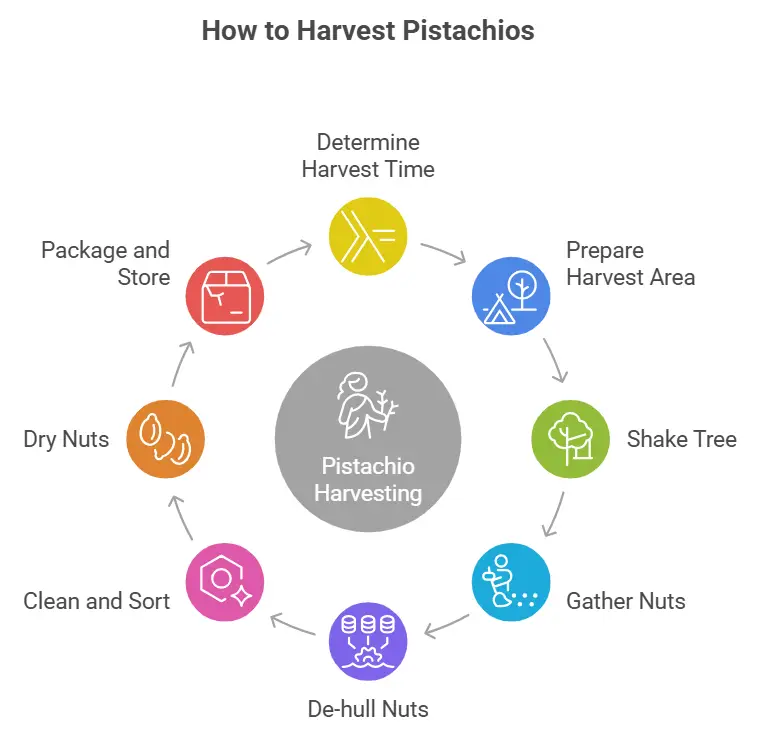
4. Gather and move freshly picked pistachios.
After the shaking, how to pick pistachios? The workers collect the nuts in the tarps in bins or bags, sort out the leaves and twigs by hand or through basic sorting screens. The nuts must be transported into the processing plant as fast as possible, preferably within a few hours, so that the wet hulls do not remain long on the shells. In the commercial systems, the freshly picked pistachios are taken by trucks to a hulling and drying plant nearby. Fast handling is especially important for export-quality types such as Ahmad Aghaei Pistachios, which are known for their appearance and need careful post-harvest management.
5. De-hull (hulling).
The outer hull of fresh pistachios is soft, and it has to be peeled in a short period of time:
- At the processing facilities, there are special hulling machines that roll or abrasively strip the hull, but do not crack the hard shell.
- Small-scale or home harvests: The hull can be peeled by hand or simply rubbed off with simple equipment, provided that it is removed within about 24 hours.
- Quickness in hulling is of very important, because if it takes too long, it may result in hull stains, bad taste, and increased susceptibility to mould.
6. Cleaning, washing and sorting.
After knowing how do they harvest pistachios, the nuts are then subjected to several quality processes after hulling:
- Washing: Pistachios are washed to eliminate pieces of hull, dust, and soil, which enhance appearance and food safety.
- Sorting: Other machines and workers take out damaged, unripe, or insect-damaged nuts, and some processors separate those nuts whose shells are opened naturally and those that are closed.
- Grading: Before the nuts undergo the drying process, they are graded according to size, shell color/external quality.
7. To the correct degree of drying pistachios.
After knowing how are pistachio nuts harvested, the nuts should be dried by using warm air until they have a safe moisture content, which in most commercial systems is around 12-13% of the moisture content. Some of them employ a two-stage drying process, which enhances efficiency and preserves the flavor and texture. Proper drying helps in avoiding mould, increases shelf life, and offers a crisp bite.
8. Packaging, storing and roasting.
Pistachios get dried and then stored, or refined:
- Dried nuts are kept in cool, dry places in bulk bins or silos in order to maintain their quality before they are required.
- Most of them are roasted later, salted or flavored, and packaged; others are sold raw in shell pistachios or kernels.
And lastly, the nuts are packed up, capped, and exported to global markets.
How Long to Harvest Pistachios?
The primary harvest normally takes four to six weeks based on climate and variety. Pistachios will take many months before flowering to mature with split shells, and this is where proper management of the orchards during the growing season is relevant.
After picking the pistachios, the processors want to have the hulling finished, and then the drying process begins in less than 24 hours, so the post harvest time is very narrow and well coordinated.
Quality Pistachios in Toucan Trade Group
Toucan Trade Group deals with the export of high-quality Iranian pistachios and other dried fruits with attention to quality control during harvesting to final packaging, which is in line with the international standards and customer demands. We are careful about processing, such as hulling, cleaning, drying and grading to choose the farmers and producers, the pistachios that are grown under the Iranian sun come out as safe and high quality. Visit our websit, choose among Fandoghi, Kalleh Ghouchi, etc. Contact us now to place your order.
FAQs
- How are pistachio nuts harvested?
Pistachio nuts are harvested by shaking the trees manually or with mechanical shakers, so ripe nuts fall onto tarps or receiving machines, then they are quickly hulled, washed, dried, and sorted. - How long does the pistachio harvest take?
The orchard harvest season typically lasts several weeks in late summer or early fall, but each batch of nuts should be hulled and dried within about 24 hours after picking to maintain quality and prevent mold. - How to buy well-harvested quality pistachios?
Visit our website, choose the best type, and contact us to place your order.
