


Over the past ten years, the level of demand of pistachios in the world market has increased because of the increase of interest in healthy snacks, plant protein, and high-quality confectionery products. What are top 10 pistachio producing countries? Iran is a special place in this landscape, particularly to the Asian, European, and the Middle East markets. In this article we will find out all other details.
Top 10 Pistachio Grown Countries
Here are some of the top pistachio producing countries:
|
Rank |
Country | Key points for buyers |
|
1 |
United States |
Large‑scale mechanized orchards, consistent supply, significant share of global output. |
|
2 |
Iran |
Historic homeland of pistachios, wide range of premium export varieties, strong flavor profile. |
|
3 |
Turkey |
Important regional supplier with growing orchards and strong domestic consumption. |
|
4 |
China |
Expanding production mainly for domestic demand, increasing presence in statistics. |
|
5 |
Syria |
Traditional producer with distinctive local varieties, limited by recent economic challenges. |
|
6 |
Greece |
Niche European producer with high‑quality kernels, often used in Mediterranean foods. |
|
7 |
Italy |
Smaller but premium‑focused production, important for confectionery and gelato sectors. |
|
8 |
Uzbekistan |
Growing orchards and rising production volumes in Central Asia. |
|
9 |
Spain |
Rapidly developing plantations, especially in suitable Mediterranean regions. |
| 10 | Tunisia |
Longstanding producer in North Africa, contributing modest but steady volumes. |
Estimates have shown that United States, Iran and Turkey are the three leading producers among the top 10 pistachio producing countries of about 90 percent of the total pistachio production, implying that most of the international trade flows are produced by these three countries. The importers tend to mix Iranian and the American pistachios to provide a balance in the flavors profile, kernel size, look, and price in the product line.
Iran Pistachio Market
It is well known that Iran is the birthplace of pistachio, and it has been growing pistachios centuries in dry and sun drenched areas which have provided perfect conditions to grow pistachios. Data and trade reports released by FAO always indicate that Iran is ranked among the top 10 pistachio producing countries in terms of volume and it is first in certain years depending on the weather conditions and crops.
Down to its climate, Iranian pistachios are usually rich in taste, contain more fat in nature and have a strong aroma that most consumers relate to premium quality. This powerful characterization of the Iranian pistachios makes them particularly appealing to the direct snacking markets as well as the luxury confectionery items in which the flavor is important. Also, Iran has a large variety of commercial grades and processing (raw, roasted, salted, in shell, kernels) depending on the needs of various markets.
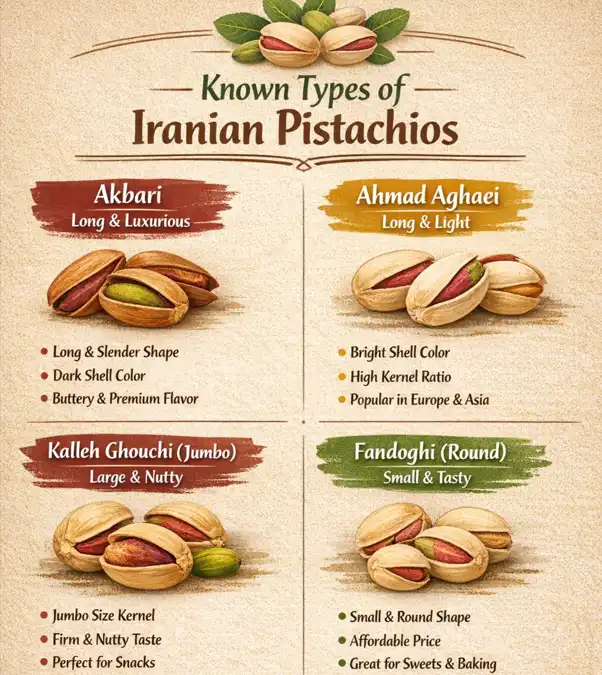
Known Types of Iranian Pistachios
Iranian pistachios, as one of the top pistachio producing countries, are typically divided into a few popular commercial varieties, each type has a typical shape, taste and typical application in the export markets.
- Akbari: It is among the longest Iranian pistachios that have a slender shape, has a dark shell color, and its flavor profile is buttery and luxurious, which serves premium and gift markets. Akbari Pistachios is usually purchased to provide the buyer with visually appealing pistachios to be used in retail package or as a gift to a VIP client.
- Ahmad Aghaei: Ahmad Aghaei pistachios are also long but slightly smaller than Akbari with bright and light colored shell and high kernel to shell ratio, so they are pleasing to the eye in the shelves of supermarkets. The reason why farmers and exporters like this, is because it has high crop and high consumer demand in markets like the Europe, India and the Middle East.
- Kalleh Ghouchi (Jumbo): Kalleh Ghouchi Pistachios (or Jumbo pistachio) has a more rounded and larger kernel and a firm and nutty flavor. Roasters and snack brands promote this variety because they desire a roasted mix with a large nut, rich in flavor that stands out.
- Fandoghi (Round): Fandoghi pistachios are smaller and rounder, which is the traditional form of the most common types that grow in Iran. Their moderate size and competitive prices render them to be good in bulk use in confectionery, ice cream, and bakery applications.
A combination of these varieties will help Iranian exporters serve various buyer profiles including cost sensitive industrial users as well as high margin premium retail brands.
Why Choose Toucan Trade Group Pistachio?
Toucan Trade Group is a supplier of Iranian pistachios and other agricultural products with reliability and quality controlled sourcing. The company collaborates with reputable suppliers and processing plants to deliver a stable supply of Akbari, Ahmad Aghaei, Kalleh Ghouchi and Fandoghi pistachios that are of international quality. Flexible order quantity, prompt delivery, and customer services are also emphasized by Toucan Trade Group to serve bulk importers and niche retailers. Visit Our website and contact us now to place your order.
FAQs
- Which Iranian pistachio variety is best for retail snack packaging?
In the case of snack packaging which is branded, Akbari and Ahmad Aghaei are favored by many importers due to their shape, beautiful shell color, and the appeal they have on the consumers.
- How are Iranian pistachios different from U.S. pistachios in flavor?
Iranian pistachios are richer and naturally sweeter because of their high content of oil and the conventional sun growth conditions. In comparison, the U.S. pistachios normally focus on uniformity, standardized grading and mass-produced production.
- What should buyers check before placing a bulk order?
The importers should ensure the type and size category, level of moisture, and defects (closed shells and foreign material), certification and packaging parameters. When dealing with a professional exporter such as Toucan Trade Group, it is easy to get a clear documentation before shipment.
